

To Trust or Not to Trust?
The answer isn't whether you need a trust—it's which one. Understanding the most common types can help you protect your family, your assets, and your legacy.



By Brett Roth, Matt Ringle, and Elliott Singer
When people hear the word trust, they often think it's something only the ultra-wealthy need. In reality, trusts are valuable estate planning tools that can benefit families at many income levels. The right trust can help you avoid probate, protect loved ones, reduce taxes, preserve assets, and ensure your wishes are carried out exactly as intended.
No single trust is "best"—each serves a different purpose. Here's an overview of the most common types and when they may be appropriate.
Revocable Living Trust
Ideal for: Flexibility, privacy, and avoiding probate
A Revocable Living Trust is the most common type of trust used in estate planning. You create it during your lifetime and maintain complete control over the assets inside it. Because it is revocable, you can amend or revoke the trust whenever your circumstances change.
Key Potential Benefits
- Avoids the time and expense of probate
- Keeps your financial affairs private (unlike a will)
- Provides seamless management of assets if you become incapacitated
- Allows for an efficient transfer of assets to your beneficiaries
Appropriate For: Individuals and families who want flexibility and a smoother transition of assets without court involvement.
Irrevocable Trust
Ideal for: Asset protection and tax planning
Unlike a revocable trust, an irrevocable trust generally cannot be changed once it's established. While this means giving up some control, it can provide significant legal and tax advantages.
Key Benefits
- Removes assets from your taxable estate
- Protects assets from future creditors and lawsuits
- Can be an effective tool for Medicaid and long-term care planning
- Helps preserve wealth for future generations
Appropriate For: Individuals with larger estates or those seeking greater asset protection.
Special Needs Trust
Ideal for: Caring for a loved one with disabilities
Providing financial support for a loved one with special needs requires careful planning. A properly structured Special Needs Trust allows assets to supplement—not replace—government benefits.
Key Potential Benefits
- Preserves eligibility for Medicaid and Supplemental Security Income (SSI)
- Provides funds for healthcare, education, transportation, recreation, and other quality-of-life expenses
- Ensures long-term financial support
Appropriate For: Families with a child or dependent who has a disability.
Charitable Trusts
Ideal for: Philanthropy with tax advantages
For individuals who wish to leave a charitable legacy, charitable trusts offer an opportunity to support meaningful causes while also receiving potential tax benefits.
Two common options include:
- Charitable Remainder Trust (CRT): Provides income to you or your beneficiaries during life, with the remaining assets ultimately going to charity.
- Charitable Lead Trust (CLT): Provides income to a charity for a period of time before the remaining assets pass to your heirs.
Key Potential Benefits
- Supports charitable organizations
- May reduce estate and income taxes
- Can generate lifetime income
- Creates a lasting philanthropic legacy
Appropriate For: Charitably inclined families seeking tax-efficient giving strategies.
Asset Protection Trust
Ideal for: Professionals and business owners
An Asset Protection Trust is designed to shield assets from future creditors and legal claims. These trusts are often established in states with favorable trust laws or, in some cases, offshore jurisdictions.
Key Potential Benefits
- Helps protect wealth from lawsuits
- Preserves family assets
- Particularly valuable for physicians, attorneys, business owners, and others in high-liability professions
Appropriate For: Individuals concerned about future legal or creditor risks.
Spendthrift Trust
Ideal for: Beneficiaries who need financial oversight
Sometimes protecting an inheritance means protecting it from the beneficiary's own spending habits. A Spendthrift Trust allows a trustee to control distributions while preventing beneficiaries from assigning or pledging their inheritance to creditors.
Key Potential Benefits
- Encourages responsible financial management
- Protects inherited assets from creditors
- Prevents rapid depletion of wealth
Appropriate For: Beneficiaries who may struggle with financial management or are vulnerable to outside influences.
Trusts at a Glance
Type of Trust | Primary Purpose | Key Benefits |
Revocable Living Trust | Flexibility and probate avoidance | Privacy, avoids probate, incapacity planning |
Irrevocable Trust | Tax and asset protection | Estate tax reduction, creditor protection, Medicaid planning |
Testamentary Trust | Managing inheritances | Protects minors, controls distributions |
Special Needs Trust | Disability planning | Preserves government benefits while providing additional support |
Charitable Trust | Philanthropy | Tax savings, charitable giving, income potential |
Asset Protection Trust | Wealth preservation | Shields assets from future lawsuits and creditors |
Spendthrift Trust | Beneficiary protection | Prevents overspending and protects from creditors |
Which Trust Is Right for You?
While every family's goals are unique, the following guidelines can help:
- Want flexibility and control during your lifetime? → Revocable Living Trust
- Looking to reduce taxes or protect assets? → Irrevocable Trust
- Planning for children or younger beneficiaries? → Testamentary Trust
- Providing for a loved one with disabilities? → Special Needs Trust
- Supporting charities while reducing taxes? → Charitable Trust
- Protecting wealth from future legal risks? → Asset Protection Trust
- Concerned about a beneficiary's financial habits? → Spendthrift Trust
The Bottom Line
A trust is much more than an estate planning document—it's a powerful way to protect the people and causes that matter most to you. Whether your goal is avoiding probate, preserving family wealth, reducing taxes, protecting a loved one with special needs, or leaving a charitable legacy, the right trust can help ensure your wishes are carried out for generations to come.
If you'd like to discuss which trust strategy may fit your family's goals, the advisors at DLAK Wealth Advisors are here to help you navigate your options and work alongside your estate planning attorney to develop a comprehensive plan that reflects your wishes and protects your legacy.
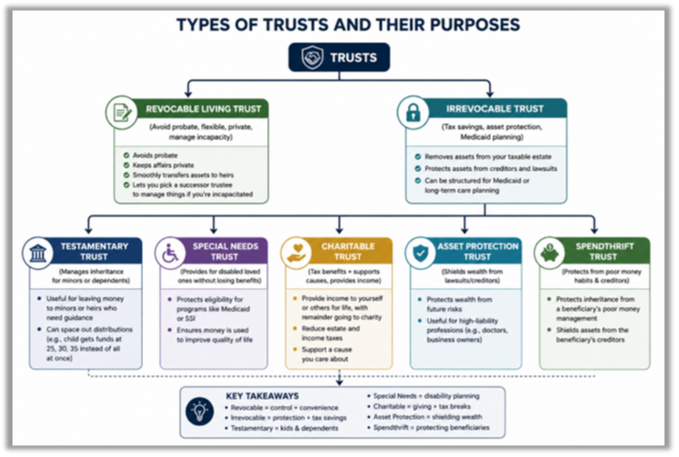
Disclosure: This chart is provided for educational purposes only and is not intended as a recommendation of any specific trust, estate planning strategy, or legal arrangement. Trusts involve complex legal considerations and may not be appropriate for every individual. Consult a qualified legal professional regarding your specific circumstances before making any trust or estate planning decisions.